
Porcelain Patio Tiles
A porcelain patio brings together everything homeowners want from an outdoor space — style, durability, and genuine year-round usability — making it one of the most popular choices for gardens across the Wirral. Whether you’re creating a dedicated dining area, a space for outdoor seating, or simply reclaiming an unused corner of the garden, porcelain patio tiles give you a surface that looks sharp from day one and stays that way with minimal effort. Bluebell Landscapes designs and installs porcelain patio slabs tailored to gardens of every size, taking care of everything from initial groundwork through to the finished, precision-laid surface.
Why Porcelain Patio Slabs Suit the Wirral Climate
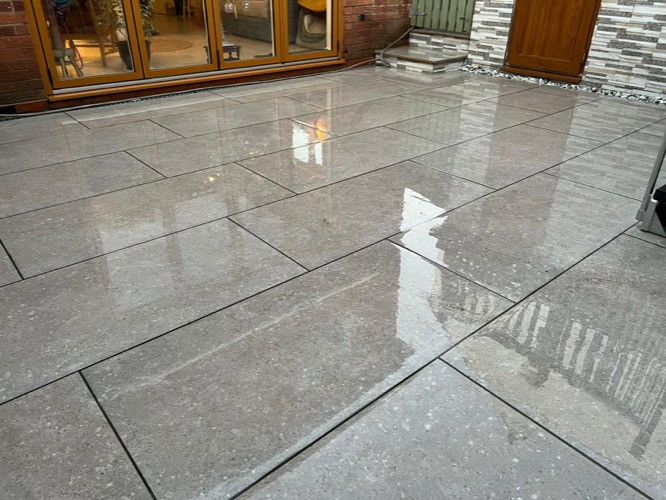
The Wirral’s mix of wet winters, occasional frosts, and warm summer spells puts real demands on outdoor surfaces, and porcelain patio slabs are particularly well suited to handling them. Because porcelain is fired at extremely high temperatures during manufacturing, it becomes dense and virtually non-porous, meaning it absorbs almost no water — this is what gives it such strong resistance to frost damage compared with more porous materials like natural stone or concrete. A porcelain patio also resists staining from food, drinks, and general garden debris, since spills sit on the surface rather than soaking in, making cleanup after a barbecue or family gathering straightforward.
Freeze-thaw damage is the specific problem porcelain avoids. When water soaks into a porous slab and then freezes, the expansion breaks the material apart from within, which is why concrete and some natural stones spall and flake after a few hard winters. A virtually non-porous slab has nowhere for that water to sit.
- Frost-proof through winters without sealing or treatment
- Colour stable under summer sun, no fading
- Sheds rain without absorbing it into the body
- Unaffected by salt or de-icing products
Porcelain Patio Tiles vs Natural Stone
One of the most common questions homeowners ask when planning a new patio is whether to choose porcelain or natural stone. Both have their place, but they perform quite differently in practice:
- Durability — porcelain is denser and stronger than most natural stone, giving it better resistance to cracking, chipping, and everyday wear.
- Maintenance — natural stone typically needs periodic sealing to prevent staining and moss growth, while porcelain patio tiles require no sealing at all thanks to their non-porous surface.
- Consistency — porcelain is manufactured to precise tolerances, giving a more uniform thickness and colour across a full patio, whereas natural stone varies naturally from slab to slab.
- Appearance — natural stone offers an organic, one-of-a-kind look, while porcelain patio slabs can replicate that same aesthetic through stone-effect finishes, while adding far greater practical performance.
For most Wirral homeowners looking for a low-maintenance, long-lasting patio that still looks the part, porcelain patio tiles tend to offer the better overall balance of style and practicality.
Slip Resistance for Safe Outdoor Living
Because patios see heavy foot traffic in all weather, slip resistance matters just as much as appearance. Outdoor-rated porcelain patio slabs are manufactured with textured surfaces and tested to R-value or Pendulum Test Value standards, with many ranges achieving an R11 rating suitable for wet, high-traffic outdoor areas. This makes a porcelain patio a genuinely practical choice for family gardens, especially around areas like outdoor dining spaces or routes to the back door that see regular use regardless of the weather.
The practical figure to ask about is the R rating. R11 is the usual choice for a domestic patio, offering solid grip underfoot without a surface so coarse it is uncomfortable barefoot or awkward to sweep clean. Higher ratings suit slopes, steps, and anywhere close to a pool.
Choosing the Right Thickness, Size and Design
Not all porcelain patio tiles are created equal, and thickness matters more than many homeowners realise. The standard recommendation for patios and general pedestrian areas is 20mm porcelain, which offers the strength needed for outdoor use when laid correctly on a full mortar bed or proper sub-base. Lighter 16mm porcelain is sometimes used for very light-traffic garden paths, but 20mm remains the safest choice for a genuine patio area that will see regular use.
In terms of slab size, larger formats such as 600x600mm, 900x600mm, or 600x1200mm have become the most popular choice for modern patios, since fewer, larger porcelain patio slabs mean fewer joint lines and a cleaner, more spacious-looking finish — particularly valuable in smaller Wirral gardens.
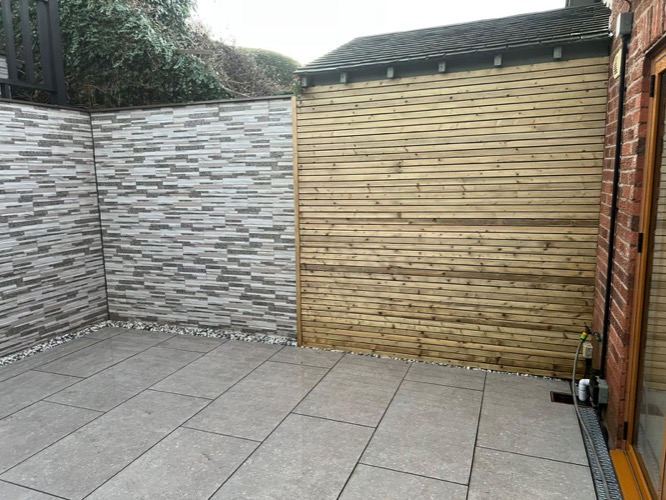
Grey remains the go-to colour for modern porcelain patio slabs, ranging from light silver-grey through to dark charcoal, and pairs particularly well with black aluminium furniture, white rendered walls, and glass balustrades for a clean, contemporary look. A growing trend among Wirral homeowners is using matching porcelain patio tiles indoors and outdoors, creating a seamless visual flow between kitchen or living areas and the garden — especially effective alongside bifold or sliding doors.
For a softer look, porcelain patio flags can be combined with grass strips between individual slabs, raised planters, or timber seating to contrast the modern material with natural textures, keeping the space feeling contemporary without becoming too stark.

How We Install Your Porcelain Patio
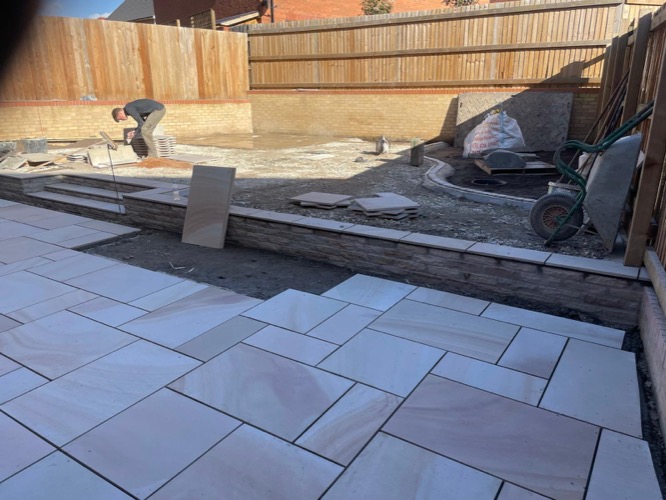
A patio porcelain slabs installation lives or dies on the quality of the groundwork beneath it. Our process begins with excavating the area to the correct depth, followed by laying and compacting a Type 1 MOT aggregate sub-base with a built-in fall of around 15mm per metre to ensure water drains away properly rather than pooling on the surface. The porcelain patio tiles are then bedded onto a full mortar bed, checked continuously with a spirit level, and finished with neatly jointed jointing compound spaced 3–10mm apart for a clean, professional result. Every stage is handled by our experienced team, so you get a patio porcelain slabs installation that performs as well as it looks for years to come.
Cutting and setting out are where a patio is visibly made or ruined. We plan the layout so that full slabs sit in the most visible positions and cuts fall at the edges, and every cut is made with a wet saw to give a clean edge rather than a chipped one. Jointing is finished to a consistent width throughout.
- Excavation to correct depth for the intended surface
- Compacted Type 1 MOT sub-base with drainage falls
- Full mortar bed and slurry primer on every slab
- Wet-cut edges for clean, consistent lines
- Joints filled and finished to a uniform width
Start Planning Your New Patio
Ready to upgrade your outdoor space with a porcelain patio built to handle everything the Wirral weather throws at it? Bluebell Landscapes provides expert design advice, supply, and installation of porcelain patio tiles tailored to your garden. Contact us today for a free consultation and tailored quote.
—
Services
- Porcelain Paving
- Porcelain Tiles Garden
- Porcelain Patio Tiles
- Grey Porcelain Paving
- Porcelain Driveway
- Porcelain Paving Near Me
- Anthracite Porcelain Paving
- White Porcelain Paving
- Beige Porcelain Paving
- Porcelain Outdoor Slabs
- Pattern Imprinted Concrete
- Landscape Gardener
- Garden Designer
- Landscape Gardener Near Me