
Porcelain Driveway

A porcelain driveway offers something few other materials can match — genuine kerb appeal paired with the strength to handle daily vehicle use, day in and day out. Once seen as purely a patio material, porcelain has become an increasingly popular choice for driveways across the UK, and Wirral homeowners are following the same trend as they look for a modern, low-maintenance alternative to block paving, tarmac, and resin. Bluebell Landscapes supplies and installs porcelain driveway pavers built to withstand years of vehicle traffic, weather, and everyday wear.

Is Porcelain Strong Enough for a Driveway?

It’s a fair question, and one we hear often — porcelain has a reputation for being used indoors on floors and walls, so it’s natural to wonder whether it can really cope with cars parking and manoeuvring on it every day. The answer is yes, provided the correct product and installation approach are used. Porcelain used for driveways is manufactured to be considerably thicker and stronger than standard patio porcelain, typically 30mm rather than the usual 20mm used on patios, and is technically approved for vehicular use. This extra thickness, combined with porcelain’s naturally dense, low-porosity structure, gives a porcelain driveway the load-bearing strength needed to support the weight of everyday family cars.

When comparing driveway materials, porcelain driveway pavers offer a distinct set of advantages over more traditional choices like block paving, resin, or tarmac:

  • Exceptional strength — porcelain can carry heavy foot traffic and vehicles without cracking or deteriorating in the way concrete or block paving sometimes can over time.
  • Extremely low water absorption — porcelain driveway slabs have a water absorption rate as low as 0.01%, making them highly resistant to staining from oil, fuel spills, and general dirt, as well as resistant to frost damage.
  • No moss or algae buildup — because moisture doesn’t penetrate the surface, porcelain resists the mould, moss, and lichen growth that can make block paving driveways look tired and patchy over time.
  • Fade-resistant finish — porcelain driveway tiles are printed with UV-stable inks that won’t fade in direct sunlight, keeping kerb appeal intact for years.
  • Consistent, precise sizing — porcelain driveway pavers are manufactured to uniform dimensions, giving cleaner joint lines and a smarter overall finish than some other driveway materials.
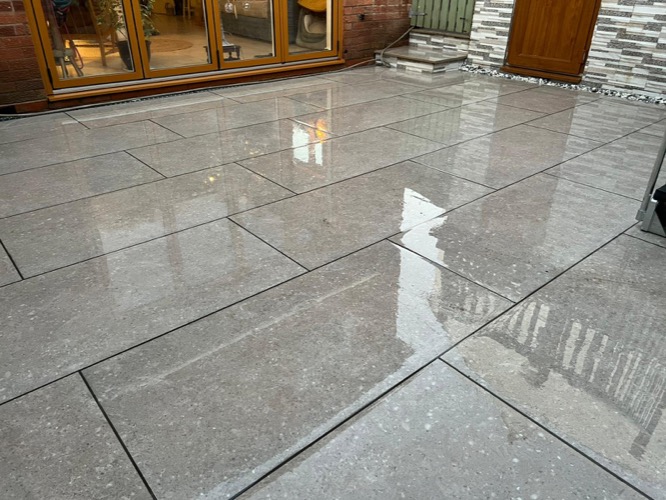
Porcelain paving driveway runcorn
Porcelain for driveways great sankey

Building the Right Foundation for a Porcelain Driveway

Because driveways carry significantly more load than patios, the sub-base requirements are considerably more demanding, and this is one of the most important factors in a successful, long-lasting installation. Driveways generally require a compacted sub-base depth of 150–200mm using Type 1 MOT aggregate, capable of supporting vehicles up to around 3.5 tonnes, compared with the 100–150mm typically used for patios. This is usually laid in two compacted layers of roughly 75mm each to achieve the necessary strength and stability.

Getting this stage right is critical — an under-specified sub-base is one of the most common causes of driveway failure, leading to cracking, sinking, or uneven settling under the weight of vehicles over time. Bluebell Landscapes builds every porcelain driveway to the correct sub-base depth for the specific vehicles and usage of your household, ensuring the finished surface performs reliably for years to come.

Slip Resistance and Safety for Driveways

Because a driveway is used in all weather conditions, from icy winter mornings to heavy summer rain, slip resistance is a genuine safety consideration, not just a comfort issue. Textured, outdoor-rated porcelain driveway pavers are tested to R-value standards, with many ranges achieving an R11 anti-slip rating suitable for driveway use, helping to reduce the risk of slipping underfoot or skidding tyres in wet or icy conditions.

Textured finishes on driveway-rated slabs are engineered into the surface during firing rather than applied as a coating, so they do not wear smooth with traffic the way a treated surface can. That matters on a driveway more than on a patio, because tyres concentrate wear along the same lines every day.

  • Slip ratings engineered into the fired surface
  • Grip retained under wheel traffic rather than wearing smooth
  • Unaffected by de-icing salt in winter
  • Suitable for slopes and inclined approaches

Design Options for Your Porcelain Driveway

Porcelain driveway tiles are available in a wide range of finishes, from granite-effect and natural stone-look designs through to sleek, contemporary single-tone greys, giving you plenty of flexibility to match your home’s existing exterior. Darker tones such as anthracite or charcoal porcelain driveway slabs tend to suit modern properties and hide everyday tyre marks and dirt well, while lighter greys or beige tones can complement more traditional brick-built homes.

Layout choices matter as much as the slab itself. Border courses in a contrasting tone define the edges and make a driveway read as deliberate rather than simply surfaced, and a change of format where the drive meets a path or entrance helps separate the two visually. These decisions are easiest to make at the planning stage, not once materials are ordered.
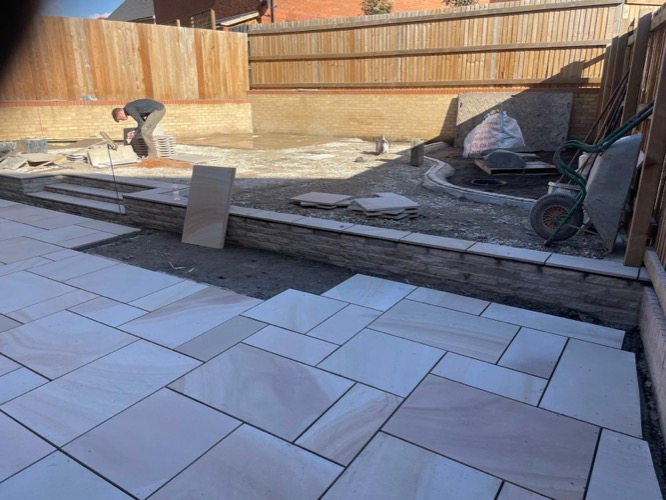
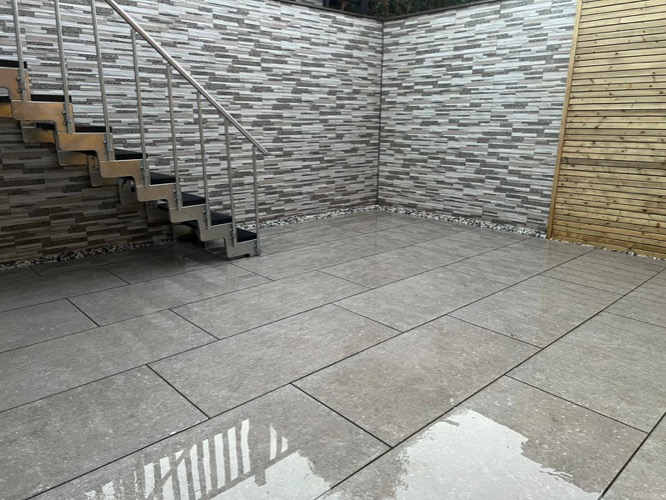
Porcelain pavers driveway widnes
Porcelain driveway slabs warrington

How We Install Your Porcelain Driveway

Every porcelain pavers driveway project starts with a full site assessment, allowing us to plan drainage, excavation depth, and sub-base specification around your specific vehicles and driveway size. We then build the sub-base in properly compacted layers, incorporate suitable drainage falls to prevent standing water, and lay the porcelain driveway slabs on a full mortar bed with precise, consistent jointing. This careful, methodical approach is what separates a driveway that performs well for decades from one that develops problems within a few years.

Driveway sub-bases are built considerably deeper than patio ones because of the point loading vehicles apply, and the depth is set against your actual vehicle weights rather than a standard figure. Edge restraint is equally important, since an unrestrained edge is where a driveway surface starts to move first.

  • Sub-base depth specified against vehicle weight and use
  • Compaction in layers rather than in one pass
  • Drainage falls planned around existing levels
  • Edge restraint installed to prevent lateral movement

Upgrade Your Driveway Today

A porcelain driveway gives your home genuine kerb appeal alongside the strength and durability to handle daily use for years to come. Bluebell Landscapes provides expert supply and installation of porcelain driveway pavers built specifically for your property and vehicles. Get in touch today for a free, tailored quote.

How much does porcelain paving cost?2026-08-03T08:38:20+00:00

UK porcelain paving typically costs £30–£70 per m² for standard ranges and £70–£120+ per m² for premium ranges, with labour adding roughly £80–£120 per m². Since garden size, access, and ground conditions all affect the final figure, Bluebell Landscapes provides a tailored quote based on your specific space rather than a flat rate.tilesandsmilesBluebell-Landscapes.csv

What is the cost of porcelain paving?2026-08-03T08:38:20+00:00

Combined material and labour costs for porcelain paving generally fall between £70 and £190+ per m², depending on slab quality and site preparation. A firm price depends entirely on your garden’s size and condition, which is why every Bluebell Landscapes quote is based on a proper site assessment.pavingshopper+1Bluebell-Landscapes.csv

What is porcelain paving cost per m2?2026-08-03T08:38:20+00:00

Material-only porcelain slabs cost roughly £20–£100 per m² in the UK, with supply-and-fit projects typically landing between £70 and £190+ per m² once labour is included. This range varies widely with groundwork needs, so a genuine per-m² figure for your project comes from a site visit.royalestones.co+1Bluebell-Landscapes.csv

What is the porcelain paving price per m2?2026-08-03T08:38:20+00:00

Porcelain paving price per m² ranges from around £19.55 at the budget end through to £120+ for premium finishes, largely driven by slab thickness, size, and origin. Because every garden differs, Bluebell Landscapes calculates price per m² individually after seeing the space.universalpaving.co+1Bluebell-Landscapes.csv

How much does it cost to lay porcelain paving?2026-08-03T08:38:20+00:00

Labour to lay porcelain paving in the UK typically costs £80–£120 per m² on top of material costs, reflecting the specialist sub-base and jointing work involved. Ground preparation complexity varies from garden to garden, so Bluebell Landscapes prices labour after assessing your site.Bluebell-Landscapes.csvtilesandsmiles

How much does a porcelain patio cost?2026-08-03T08:38:20+00:00

A typical 20m² porcelain patio costs roughly £2,400–£4,400 in total once materials and labour are combined, though this shifts with slab choice and site conditions. Patio shape, size, and existing ground conditions all affect the final price, so Bluebell Landscapes quotes each patio individually.tilesandsmilesBluebell-Landscapes.csv

What is the cost of a porcelain patio?2026-08-03T08:38:20+00:00

Total porcelain patio costs in the UK generally range from £110–£190+ per m² supply-and-fit, varying by tile quality and preparation needs. As no two patios are the same size, Bluebell Landscapes provides a bespoke figure after visiting your garden.pavingshopper+1Bluebell-Landscapes.csv

What is porcelain patio cost per m2?2026-08-03T08:38:20+00:00

Porcelain patios typically cost £110–£190+ per m² installed in the UK, with premium finishes pushing costs higher. This depends heavily on patio size and groundwork, so Bluebell Landscapes assesses each project individually.Bluebell-Landscapes.csvtilesandsmiles+1

How much does a porcelain driveway cost?2026-08-03T08:38:20+00:00

Porcelain driveways generally cost more per m² than patios because they need a stronger sub-base to support vehicle weight, with material prices starting around £20–£100 per m² before labour. Driveway size and current surface condition vary significantly between properties, so Bluebell Landscapes tailors a quote to each driveway.royalestones.coBluebell-Landscapes.csv

How much do porcelain pavers cost?2026-08-03T08:38:20+00:00

Outdoor porcelain pavers cost roughly £20–£100 per m² for materials in the UK, with total installed cost often reaching £70–£190+ per m² once labour is added. Given how much this depends on your outdoor space, Bluebell Landscapes provides a project-specific quote.royalestones.co+1Bluebell-Landscapes.csv

What is the cost of porcelain pavers?2026-08-03T08:38:20+00:00

Porcelain paver costs vary by slab thickness, finish, and the groundwork your space requires, generally landing between £70 and £190+ per m² installed. An accurate figure depends on your garden’s size and layout, best confirmed on-site.pavingshopperBluebell-Landscapes.csv

What is porcelain pavers price?2026-08-03T08:38:20+00:00

Porcelain paver prices range from about £20 per m² for budget material-only options up to £120+ per m² for premium ranges. Bluebell Landscapes quotes based on your specific project rather than a generic rate.universalpaving.co+1Bluebell-Landscapes.csv

What is porcelain pavers cost per square foot?2026-08-03T08:38:20+00:00

Converting UK per-m² pricing, porcelain pavers cost roughly £2–£11 per square foot for materials, translating to about £6.50–£17.60 per square foot installed. Because pricing depends on total area and site prep, Bluebell Landscapes calculates this after seeing your garden.Bluebell-Landscapes.csvpavingshopper

What is the best price for porcelain paving?2026-08-03T08:38:20+00:00

The best price comes from comparing full supply-and-fit quotes rather than material cost alone, since installation quality significantly affects long-term durability. Bluebell Landscapes provides a complete, itemised quote so you can see exactly what’s included.londonstone.coBluebell-Landscapes.csv

What are porcelain paving prices?2026-08-03T08:38:20+00:00

Porcelain paving prices in the UK span from around £19.55 per m² at the budget end to £120+ per m² for premium ranges, plus £80–£120 per m² labour. Since prices vary by project, Bluebell Landscapes assesses your garden before confirming a figure.universalpaving.co+1Bluebell-Landscapes.csv

How do you lay porcelain slabs?2026-08-03T08:38:20+00:00

Porcelain slabs are typically laid on a full mortar bed or specialist adhesive over a properly prepared sub-base, with joint spacing of 3–10mm recommended for outdoor use. Professional installation is strongly recommended over DIY, since incorrect sub-base preparation is one of the most common causes of later problems.naturalstoneandtimber

Is a porcelain paving installer necessary, or can it be a DIY job?2026-08-03T08:38:20+00:00

While it’s possible to lay porcelain paving yourself, manufacturers generally recommend professional installation due to the precision needed in sub-base preparation and jointing. A qualified installer like Bluebell Landscapes ensures the groundwork, drainage falls, and joint spacing meet manufacturer specifications for long-term performance.milesstone.coBluebell-Landscapes.csv

Is porcelain paving slippery?2026-08-03T08:38:20+00:00

Outdoor porcelain paving is manufactured with anti-slip textured surfaces rated using the R-value system (R9 to R13), making it less slippery than many other paving materials when properly specified. This makes it a safe choice for the UK’s wet climate, including around pools and high-traffic patio areas.rubi

Does porcelain paving scratch or stain?2026-08-03T08:38:20+00:00

Porcelain paving is highly resistant to scratching and staining due to its dense, non-porous surface, which prevents spills and dirt from penetrating the material. This also means it resists mould and mildew, keeping patios looking newer for longer with minimal cleaning.rubi

Can porcelain paving withstand UK weather?2026-08-03T08:38:20+00:00

Yes — porcelain paving is frost-resistant, UV-resistant, and handles thermal expansion well, making it well-suited to the UK’s mix of rain, frost, and occasional heat. Its low water absorption rate (under 0.5%) prevents the freeze-thaw cracking that can affect other paving materials.

Where we are

Go to Top