
White Porcelain Paving

White porcelain paving offers something quite different from the greys and darker tones that dominate most UK gardens — a bright, crisp finish that opens up a space and makes it feel noticeably larger and more open. For smaller or more enclosed Wirral gardens that don’t get a huge amount of direct sunlight, white porcelain paving slabs can make a genuine difference to how the space feels day to day. Bluebell Landscapes supplies and installs white porcelain patio tiles suited to gardens looking for a fresh, contemporary, light-filled finish.

The Case for Choosing White Porcelain Paving

White porcelain paving comes with a distinct set of benefits that go beyond simply looking clean and modern:

  • Light reflection and space — white porcelain paving reflects natural light rather than absorbing it, making outdoor areas feel larger and brighter, which is particularly valuable for small or shaded gardens.
  • Keeps cooler underfoot — because light colours reflect heat rather than absorb it, white porcelain patio slabs stay noticeably cooler to walk on during hot summer days compared with darker paving.
  • Timeless, elegant appearance — the clean, crisp look of white porcelain patio tiles suits both contemporary and more classic garden designs, giving it broader appeal than some bolder colour choices.
  • Full porcelain durability — despite its lighter appearance, white porcelain paving offers exactly the same resistance to scratching, fading, and weather damage as any other porcelain colourway, since the performance comes from the material itself rather than the pigment.

The practical trade-off is upkeep. A bright surface shows leaf tannin, soil splash, and algae sooner than a mid-tone would, so it benefits from a wash a couple of times a year rather than an occasional one. That is a maintenance decision rather than a defect, but it is worth making with open eyes.
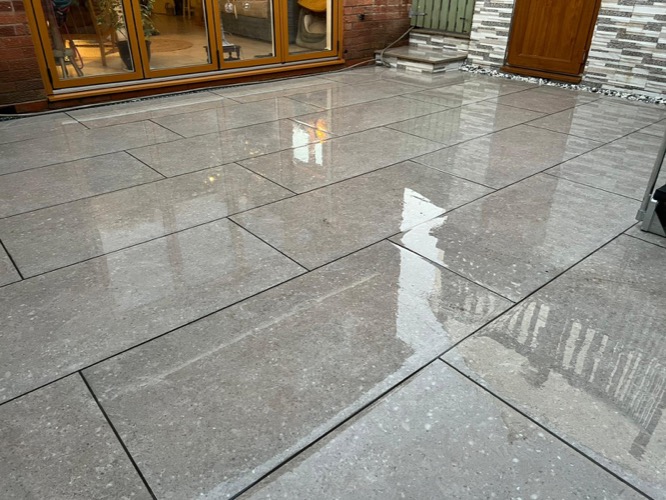
White porcelain patio tiles ellesmere port
White porcelain patio slabs newton le willows

Is White Porcelain Right for Every Garden?

While white porcelain paving has clear advantages, it’s worth being honest that it isn’t automatically the best choice for every space. Because it’s such a clean, contemporary material, white porcelain patio slabs tend to suit modern extensions, minimalist planting schemes, and coastal-style gardens particularly well, but may feel slightly at odds with a more traditional, cottage-style property. It’s also worth thinking about how white porcelain will sit alongside your existing garden features — plants, furniture, and the exterior of your home — since its brightness works best when it complements rather than clashes with the surrounding design.

Practical use matters as much as style. A bright surface under heavy tree cover collects leaf tannin and organic staining more visibly than a mid-tone would, and a garden used constantly by dogs or young children will show marks sooner. None of this rules white out, but it does mean accepting slightly more frequent washing to keep it looking as intended.

  • Best suited to contemporary and minimalist schemes
  • Brightens enclosed, shaded or north-facing gardens
  • Shows organic staining more readily under trees
  • Needs washing more often than mid-tone slabs

Keeping White Porcelain Paving Looking Its Best

A common concern homeowners raise about a white porcelain patio is whether the lighter colour will show marks more than a darker alternative. In practice, because porcelain is non-porous, white porcelain paving slabs resist staining and moisture absorption just as effectively as any other colour — spills and dirt sit on the surface rather than soaking in, so they’re generally easy to remove. That said, in areas prone to falling leaves, mud, or heavy bird activity, white porcelain patio tiles may need slightly more regular sweeping and the occasional wash to keep that bright, fresh look consistent.

For day-to-day care, a soft-bristle broom to remove loose debris, combined with an occasional wash using warm water and a mild, pH-neutral detergent, is generally all that’s needed. For any tougher marks, a mixture of warm water and a small amount of white vinegar or washing-up liquid, applied with a soft brush, will lift most residue without damaging the surface — harsh bleach or ammonia-based cleaners should always be avoided on porcelain.

Design Ideas for White Porcelain Patio Tiles

White porcelain patio slabs work particularly well paired with lush green planting, since the contrast makes foliage colours genuinely pop against the bright, neutral backdrop. It’s also a popular choice for gardens with limited natural light, where white porcelain patio tiles can be used to visually “borrow” brightness and make the space feel more open than its actual dimensions. For a softer, less stark look, white porcelain can be combined with natural timber decking, rattan furniture, or a warm-toned quartz white porcelain paving variant, which introduces subtle texture without losing the light-reflecting benefits.

The same brightness that lifts a shaded garden can feel stark in full sun, so it is worth considering how much direct light the space gets through the middle of the day. Softening the scheme with planting, timber, or a warmer-toned border course usually resolves it without abandoning the white surface altogether.
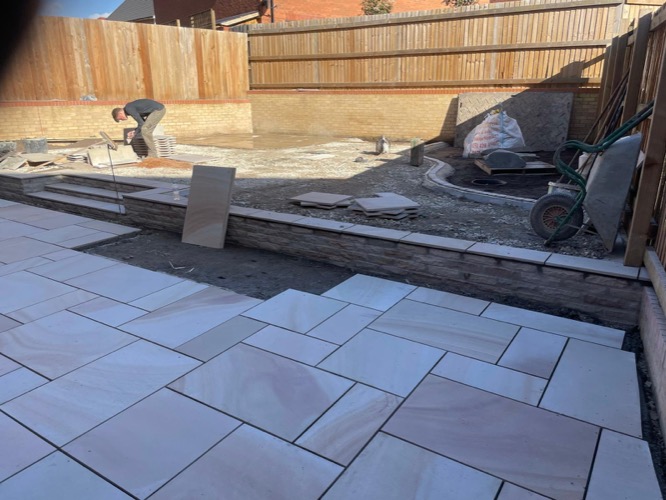
White porcelain patio rainhill
Quartz white porcelain paving ashton in makerfield

Installing Your White Porcelain Patio

Precise, careful installation matters just as much with white porcelain patio tiles as with any other colour, and arguably more so, since any unevenness or grout staining tends to show more visibly against a bright surface. We prepare a properly compacted sub-base with correct drainage falls for every white porcelain paving slabs project, then bed the tiles on a full mortar bed, checking continuously for level, before finishing with neat, precisely applied jointing to keep the overall look as clean as the material itself.

Jointing colour deserves particular thought on a white surface. A joint compound that reads grey against a bright slab draws the eye to every line, whereas a closely matched tone lets the surface read as continuous. We agree the jointing colour before installation rather than defaulting to whatever is standard.

  • Compacted sub-base with correct drainage falls
  • Full mortar bed to avoid uneven settlement
  • Jointing colour agreed before installation
  • Careful handling to avoid site staining during laying

Brighten Your Garden Today

Give your outdoor space a fresh, light, contemporary finish with white porcelain paving from Bluebell Landscapes. Get in touch today for expert advice and a free, tailored quote.

How much does porcelain paving cost?2026-08-03T08:38:20+00:00

UK porcelain paving typically costs £30–£70 per m² for standard ranges and £70–£120+ per m² for premium ranges, with labour adding roughly £80–£120 per m². Since garden size, access, and ground conditions all affect the final figure, Bluebell Landscapes provides a tailored quote based on your specific space rather than a flat rate.tilesandsmilesBluebell-Landscapes.csv

What is the cost of porcelain paving?2026-08-03T08:38:20+00:00

Combined material and labour costs for porcelain paving generally fall between £70 and £190+ per m², depending on slab quality and site preparation. A firm price depends entirely on your garden’s size and condition, which is why every Bluebell Landscapes quote is based on a proper site assessment.pavingshopper+1Bluebell-Landscapes.csv

What is porcelain paving cost per m2?2026-08-03T08:38:20+00:00

Material-only porcelain slabs cost roughly £20–£100 per m² in the UK, with supply-and-fit projects typically landing between £70 and £190+ per m² once labour is included. This range varies widely with groundwork needs, so a genuine per-m² figure for your project comes from a site visit.royalestones.co+1Bluebell-Landscapes.csv

What is the porcelain paving price per m2?2026-08-03T08:38:20+00:00

Porcelain paving price per m² ranges from around £19.55 at the budget end through to £120+ for premium finishes, largely driven by slab thickness, size, and origin. Because every garden differs, Bluebell Landscapes calculates price per m² individually after seeing the space.universalpaving.co+1Bluebell-Landscapes.csv

How much does it cost to lay porcelain paving?2026-08-03T08:38:20+00:00

Labour to lay porcelain paving in the UK typically costs £80–£120 per m² on top of material costs, reflecting the specialist sub-base and jointing work involved. Ground preparation complexity varies from garden to garden, so Bluebell Landscapes prices labour after assessing your site.Bluebell-Landscapes.csvtilesandsmiles

How much does a porcelain patio cost?2026-08-03T08:38:20+00:00

A typical 20m² porcelain patio costs roughly £2,400–£4,400 in total once materials and labour are combined, though this shifts with slab choice and site conditions. Patio shape, size, and existing ground conditions all affect the final price, so Bluebell Landscapes quotes each patio individually.tilesandsmilesBluebell-Landscapes.csv

What is the cost of a porcelain patio?2026-08-03T08:38:20+00:00

Total porcelain patio costs in the UK generally range from £110–£190+ per m² supply-and-fit, varying by tile quality and preparation needs. As no two patios are the same size, Bluebell Landscapes provides a bespoke figure after visiting your garden.pavingshopper+1Bluebell-Landscapes.csv

What is porcelain patio cost per m2?2026-08-03T08:38:20+00:00

Porcelain patios typically cost £110–£190+ per m² installed in the UK, with premium finishes pushing costs higher. This depends heavily on patio size and groundwork, so Bluebell Landscapes assesses each project individually.Bluebell-Landscapes.csvtilesandsmiles+1

How much does a porcelain driveway cost?2026-08-03T08:38:20+00:00

Porcelain driveways generally cost more per m² than patios because they need a stronger sub-base to support vehicle weight, with material prices starting around £20–£100 per m² before labour. Driveway size and current surface condition vary significantly between properties, so Bluebell Landscapes tailors a quote to each driveway.royalestones.coBluebell-Landscapes.csv

How much do porcelain pavers cost?2026-08-03T08:38:20+00:00

Outdoor porcelain pavers cost roughly £20–£100 per m² for materials in the UK, with total installed cost often reaching £70–£190+ per m² once labour is added. Given how much this depends on your outdoor space, Bluebell Landscapes provides a project-specific quote.royalestones.co+1Bluebell-Landscapes.csv

What is the cost of porcelain pavers?2026-08-03T08:38:20+00:00

Porcelain paver costs vary by slab thickness, finish, and the groundwork your space requires, generally landing between £70 and £190+ per m² installed. An accurate figure depends on your garden’s size and layout, best confirmed on-site.pavingshopperBluebell-Landscapes.csv

What is porcelain pavers price?2026-08-03T08:38:20+00:00

Porcelain paver prices range from about £20 per m² for budget material-only options up to £120+ per m² for premium ranges. Bluebell Landscapes quotes based on your specific project rather than a generic rate.universalpaving.co+1Bluebell-Landscapes.csv

What is porcelain pavers cost per square foot?2026-08-03T08:38:20+00:00

Converting UK per-m² pricing, porcelain pavers cost roughly £2–£11 per square foot for materials, translating to about £6.50–£17.60 per square foot installed. Because pricing depends on total area and site prep, Bluebell Landscapes calculates this after seeing your garden.Bluebell-Landscapes.csvpavingshopper

What is the best price for porcelain paving?2026-08-03T08:38:20+00:00

The best price comes from comparing full supply-and-fit quotes rather than material cost alone, since installation quality significantly affects long-term durability. Bluebell Landscapes provides a complete, itemised quote so you can see exactly what’s included.londonstone.coBluebell-Landscapes.csv

What are porcelain paving prices?2026-08-03T08:38:20+00:00

Porcelain paving prices in the UK span from around £19.55 per m² at the budget end to £120+ per m² for premium ranges, plus £80–£120 per m² labour. Since prices vary by project, Bluebell Landscapes assesses your garden before confirming a figure.universalpaving.co+1Bluebell-Landscapes.csv

How do you lay porcelain slabs?2026-08-03T08:38:20+00:00

Porcelain slabs are typically laid on a full mortar bed or specialist adhesive over a properly prepared sub-base, with joint spacing of 3–10mm recommended for outdoor use. Professional installation is strongly recommended over DIY, since incorrect sub-base preparation is one of the most common causes of later problems.naturalstoneandtimber

Is a porcelain paving installer necessary, or can it be a DIY job?2026-08-03T08:38:20+00:00

While it’s possible to lay porcelain paving yourself, manufacturers generally recommend professional installation due to the precision needed in sub-base preparation and jointing. A qualified installer like Bluebell Landscapes ensures the groundwork, drainage falls, and joint spacing meet manufacturer specifications for long-term performance.milesstone.coBluebell-Landscapes.csv

Is porcelain paving slippery?2026-08-03T08:38:20+00:00

Outdoor porcelain paving is manufactured with anti-slip textured surfaces rated using the R-value system (R9 to R13), making it less slippery than many other paving materials when properly specified. This makes it a safe choice for the UK’s wet climate, including around pools and high-traffic patio areas.rubi

Does porcelain paving scratch or stain?2026-08-03T08:38:20+00:00

Porcelain paving is highly resistant to scratching and staining due to its dense, non-porous surface, which prevents spills and dirt from penetrating the material. This also means it resists mould and mildew, keeping patios looking newer for longer with minimal cleaning.rubi

Can porcelain paving withstand UK weather?2026-08-03T08:38:20+00:00

Yes — porcelain paving is frost-resistant, UV-resistant, and handles thermal expansion well, making it well-suited to the UK’s mix of rain, frost, and occasional heat. Its low water absorption rate (under 0.5%) prevents the freeze-thaw cracking that can affect other paving materials.

Where we are

Go to Top